
- runs a tree of experiments: proposes hypotheses, then implements and verifies each one;
- deploys the best solution on the target stack;
- learns from the run: credit goes to each hypothesis and implementation by its impact on the outcome, and the bank is updated, every lesson carrying a credence score and a boundary on where it applies.
Kapso object.
Kapso is open source, by Leeroo. The source lives at github.com/Leeroo-AI/kapso and the package installs with pip install leeroo-kapso.
The whole thing in twelve lines
kapso build --brief kapso-brief.md --evaluation evaluation --data data --repo . --output ../churn-build --detach, then kapso watch ../churn-build --follow. Your first build runs it on the churn example.
The four parts
Smart experimentation
build() runs a tree of experiments: each node records the hypothesis, the implementation on its own branch, the budget used and the distance to the objective. For each experiment, an ideation module proposes ideas from earlier experiments and the bank of lessons, re-ranks them by expected return against the budget each would use, and sends the top-ranked ones to the implementor; a fingerprinted evaluator that no experiment can access verifies the result, and the modules can propose updates to the metrics and criteria for the verifier to approve. When a session needs a credential or a file only you can provide, the campaign asks and pauses until you reply.Learning
learn() turns a finished run into lessons: each is induced or deduced from the run’s traces, carries a credence score, a boundary on where it applies and its evidence, and is updated from its effect on the outcome; every change to the bank is A/B tested by running the same build with and without it, so an improvement is measured, not guessed. load_experience() names what the next build is served: your bank, a bank your team shares, Leeroopedia, or a corpus add_experience() ingested from a repository or a researched question. The bank is built on git, so kapso experience share, list and update pass it around.Deployment
deploy() runs a shorter experimentation of the same kind to adapt the best solution to the target stack: a session adapts a copy of the node, deploys it, and demonstrates health checks and a working call. Docker, Modal, BentoCloud and LangGraph Platform ship; a harness adds a target.Domain adaptation
A harness is Kapso’s domain package: the knowledge and workflows of an area such as predictive modelling, so a build does not experiment and learn from scratch. A run starts from a domain harness and an empty bank of lessons, and over time the harness carries the bank that accumulated what worked in that environment. Write your initial domain harness, your instructions, code, guardrails and checks, with
/kapso:harness in the plugin or kapso harness in the CLI.learn() mines your own finished campaigns into your bank; add_experience() ingests outside sources into an index. A build is served exactly what it loads.Results
IOAI 2026
In one autonomous session of the AI Model Track, Kapso scored 536.07, graded by the organizers on their hardware, above every one of the 471 human contestants, and took the IOAI² Grand Master Trophy, top 3 among all AI systems entered.
RelBench
First on all three official leaderboards of Stanford’s benchmark for predictive ML over relational data: classification, regression and recommendations, ahead of Stanford STAR’s RT-J and KumoRFM-v2.
MLE-Bench
Top ranking among open-source systems on Kaggle machine-learning competitions.
ALE-Bench
Top ranking on long-horizon algorithmic discovery problems from AtCoder.
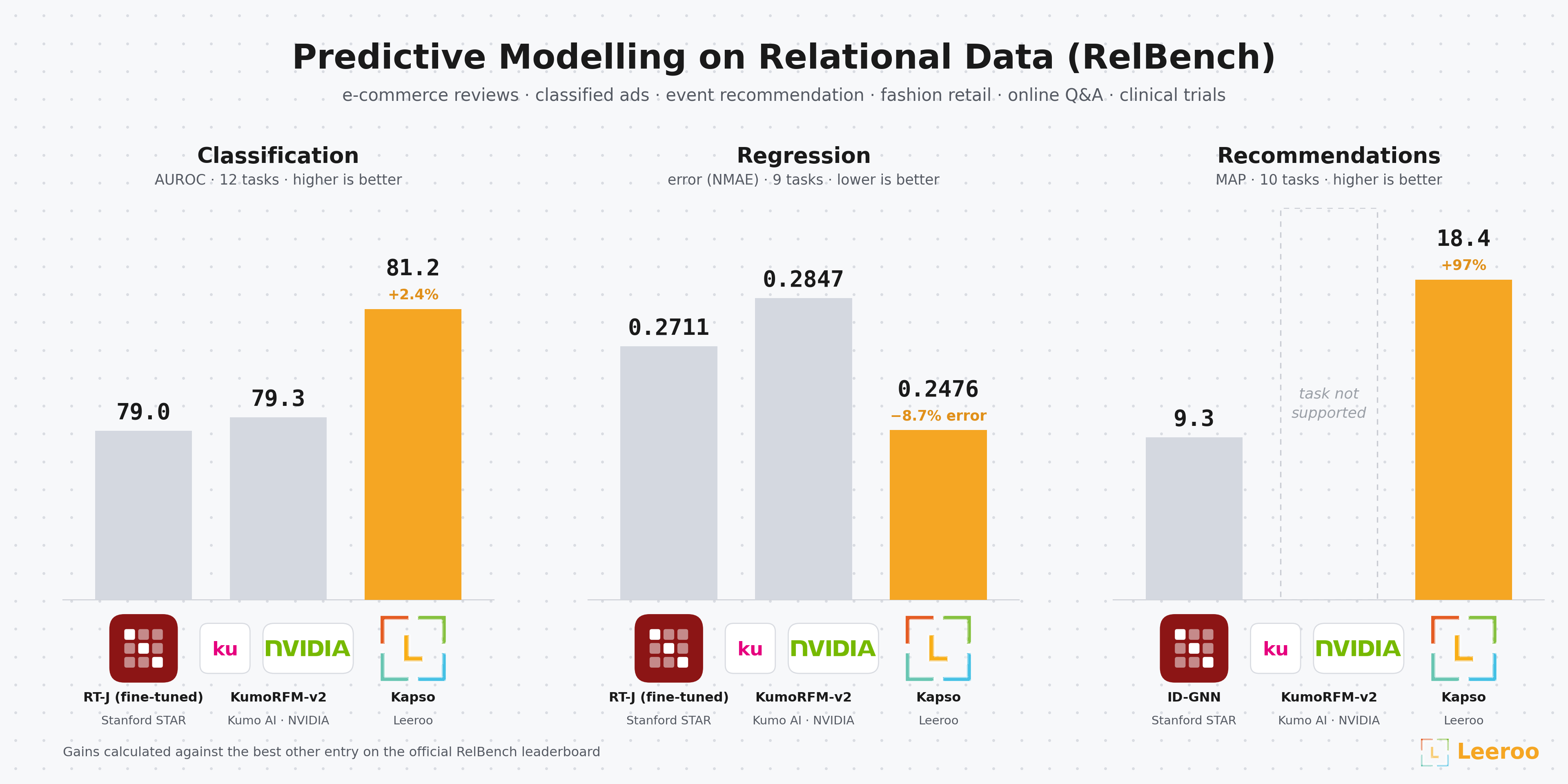
Kapso against the official RelBench leaderboard entries of Stanford STAR and Kumo AI
What is inside
Leeroopedia MCP
Kapso connects to Leeroopedia, a wiki of our lessons in the data and ML domains: around 100k pages extracted by experimenting on papers and repositories, serving about 6M requests a month, around 28% of them from AI agents. Agents query it during ideation and implementation to look up APIs, build plans and diagnose failures. See Connect Leeroopedia.Start here
Install
The CLIs, the package, and kapso doctor
Your first build
The churn example, end to end
The brief
What a build takes
pip install leeroo-kapso · Every page as plain text: llms.txt.