
Results
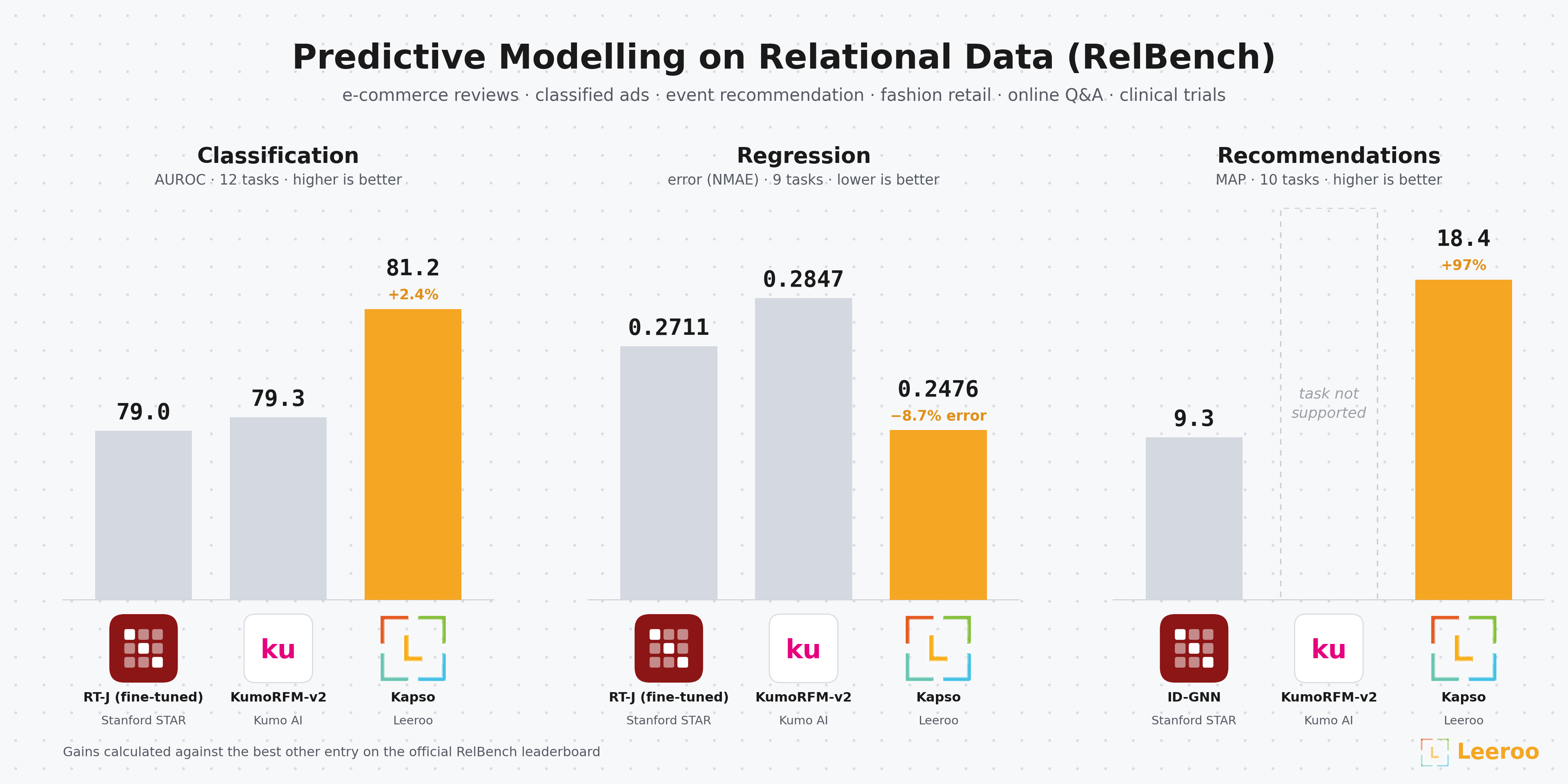
Kapso against the official RelBench leaderboard entries of Stanford STAR and Kumo AI
All Kapso scores come from the official RelBench evaluator on the official task sets; the
comparison numbers are the methods’ own entries on the
official RelBench leaderboard, read on
2026-10-11. The leaderboard is self-reported and sets no hardware or time budget, so no claim is
made about either. KumoRFM-v2 is on the board as KumoRelational, the open release from the
KumoRFM-2 paper. Neither it nor RT-J has a recommendation entry, so there the bar is ID-GNN, a
RelBench baseline, at 9.3 mean MAP over the same ten tasks.
How Kapso runs it
Each experiment in the tree search is implemented by the coding agent on a git branch and then evaluated byRelBenchHandler:
- The candidate’s
main.pyruns against a sanitized, read-only RelBench cache: the database is physically truncated at the test cutoff (or, for autocomplete, post-cutoff target values are blanked), and the test task table carries only entity ids and timestamps — test labels are physically absent from the candidate’s process. - The candidate writes
val_predictions.npyandtest_predictions.npyto$KAPSO_RUN_DATA_DIR(contract validated: shapes, dtypes, ranges). - The handler computes official validation metrics — the search score — and
computes test metrics privately (quarantined until
final_evaluate). final_evaluatepicks the best-by-validation run, audits its code for forbidden access patterns, and writes a leaderboard-readyfinal_report.json.
kapso_datasets/.
Usage
CLI options
Setup
~/.cache/relbench on first use. See
benchmarks/relbench/README.md for the campaign plan, protocol guarantees, and
per-family strategy notes.
Related
Installation
Installing the harness
Trajectory learning
Banking what a campaign learned
pip install leeroo-kapso · Every page as plain text: llms.txt.