> ## Documentation Index
> Fetch the complete documentation index at: https://docs.leeroo.com/llms.txt
> Use this file to discover all available pages before exploring further.
# ALE-Bench
> Solving AtCoder algorithmic optimization problems
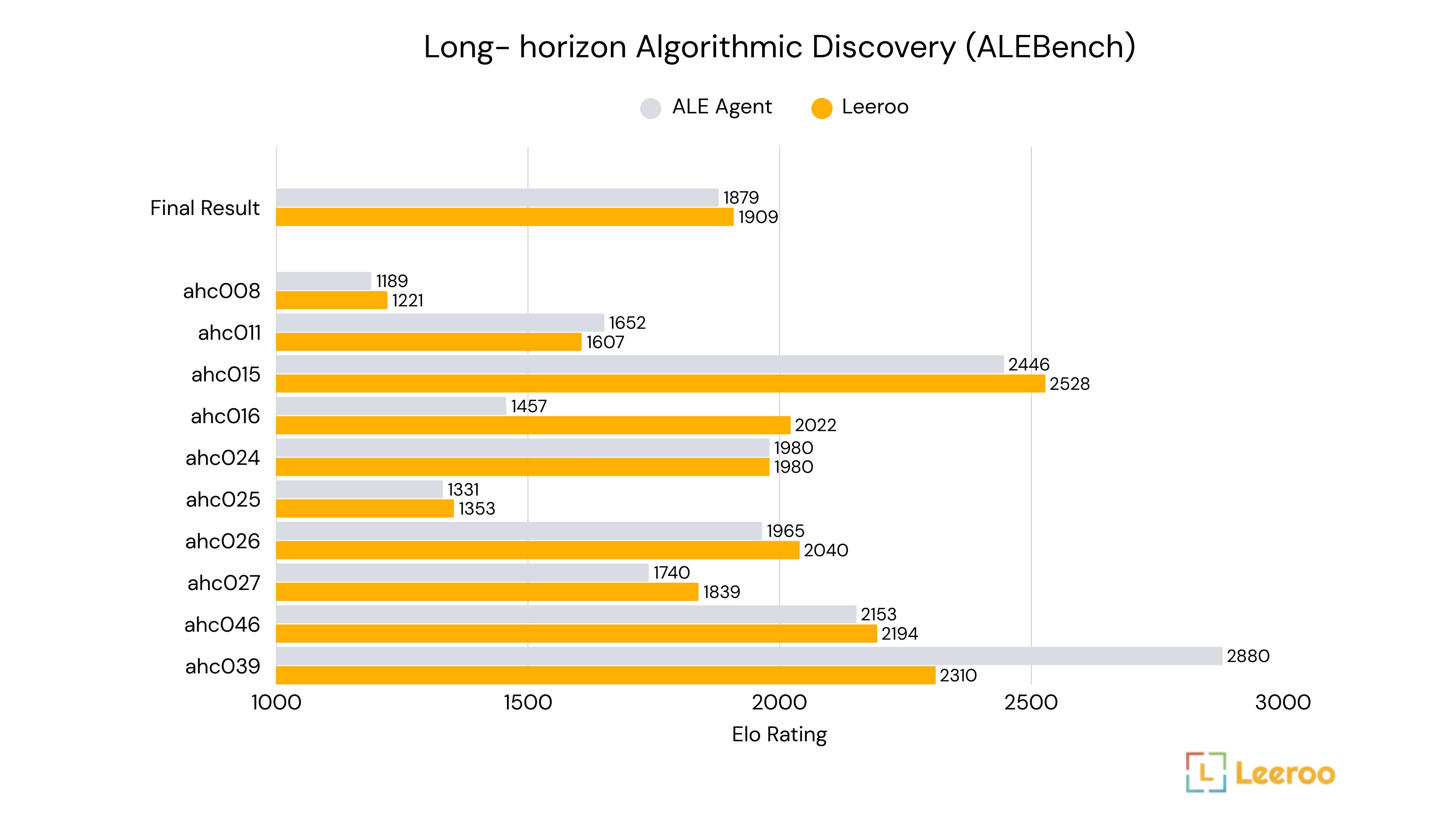
ALE-Bench provides AtCoder Heuristic Contest problems for evaluating algorithmic optimization agents. Kapso achieved **#1 on ALE-Bench**.
 ## Usage
```bash theme={null}
# List available problems
PYTHONPATH=. python -m benchmarks.ale.runner --list
# List lite benchmark problems
PYTHONPATH=. python -m benchmarks.ale.runner --lite
# Solve a problem
PYTHONPATH=. python -m benchmarks.ale.runner -p ahc039
# With options
PYTHONPATH=. python -m benchmarks.ale.runner \
-p ahc039 \
-i 14 \
-m ALE_CONFIGS \
-d aider
```
## CLI Options
| Option | Description | Default |
| -------------------- | --------------------------- | ------------- |
| `-p, --problem` | Problem ID (e.g., `ahc039`) | Required |
| `-i, --iterations` | Max experiment iterations | 14 |
| `-m, --mode` | Config mode | `ALE_CONFIGS` |
| `-d, --coding-agent` | Coding agent | From config |
| `--list` | List all problems | - |
| `--lite` | List lite problems | - |
| `--list-agents` | List coding agents | - |
## Available Problems
`ahc008`, `ahc011`, `ahc015`, `ahc016`, `ahc024`, `ahc025`, `ahc026`, `ahc027`, `ahc039`, `ahc046`
ALE-Bench uses `benchmark_tree_search` strategy which uses the handler's built-in evaluation via `handler.run()`. This is different from `kapso.evolve()` which uses agent-built evaluation.
## Output Structure
The agent generates:
```
experiment_workspace/{uuid}/
├── main.cpp # C++ solution
├── pre_run.cpp # Optional precomputation (max 1 min)
└── sessions/ # Experiment branches
```
## Evaluation
```mermaid theme={null}
flowchart LR
A[main.cpp] --> B[Docker Container]
B --> C[Compile]
C --> D[Run Tests]
D --> E{All Pass?}
E -->|Yes| F[Run 4x]
F --> G[Average Score]
E -->|No| H[Error Details]
```
The evaluation process works as follows:
1. **Code Submission**: The `main.cpp` file is read from the experiment workspace
2. **Docker Evaluation**: Code is sent to `ale_bench.public_eval()` which compiles and runs in an isolated Docker container
3. **Test Execution**: Solution runs against all test cases with strict time limits
4. **Validation**: Each test case must return `ACCEPTED` with a non-zero score
5. **Score Stabilization**: If all tests pass, the solution runs **4 additional times** and scores are averaged for stability
6. **Final Ranking**: Private evaluation compares against original contest participants
## Code Requirements
Generated C++ must:
* Be time-aware (limit: time\_limit - 100ms for I/O)
* Handle all input constraints
* Use efficient algorithms and data structures
* Include compiler optimization pragmas if helpful
## Built-in Domain Knowledge
The handler includes tips for common algorithms:
* Design good state representation
* Balance small and large moves
* Avoid recomputation in legality checks
* Keep regret mechanism for constrained problems
* Balance diversity and quality in beams
* Fast-stop bad solutions
* Use strong heuristic scoring
* Define strong heuristic scoring
* Consider average and std of scores
* Balance greedy vs long-horizon moves
## Usage
```bash theme={null}
# List available problems
PYTHONPATH=. python -m benchmarks.ale.runner --list
# List lite benchmark problems
PYTHONPATH=. python -m benchmarks.ale.runner --lite
# Solve a problem
PYTHONPATH=. python -m benchmarks.ale.runner -p ahc039
# With options
PYTHONPATH=. python -m benchmarks.ale.runner \
-p ahc039 \
-i 14 \
-m ALE_CONFIGS \
-d aider
```
## CLI Options
| Option | Description | Default |
| -------------------- | --------------------------- | ------------- |
| `-p, --problem` | Problem ID (e.g., `ahc039`) | Required |
| `-i, --iterations` | Max experiment iterations | 14 |
| `-m, --mode` | Config mode | `ALE_CONFIGS` |
| `-d, --coding-agent` | Coding agent | From config |
| `--list` | List all problems | - |
| `--lite` | List lite problems | - |
| `--list-agents` | List coding agents | - |
## Available Problems
`ahc008`, `ahc011`, `ahc015`, `ahc016`, `ahc024`, `ahc025`, `ahc026`, `ahc027`, `ahc039`, `ahc046`
ALE-Bench uses `benchmark_tree_search` strategy which uses the handler's built-in evaluation via `handler.run()`. This is different from `kapso.evolve()` which uses agent-built evaluation.
## Output Structure
The agent generates:
```
experiment_workspace/{uuid}/
├── main.cpp # C++ solution
├── pre_run.cpp # Optional precomputation (max 1 min)
└── sessions/ # Experiment branches
```
## Evaluation
```mermaid theme={null}
flowchart LR
A[main.cpp] --> B[Docker Container]
B --> C[Compile]
C --> D[Run Tests]
D --> E{All Pass?}
E -->|Yes| F[Run 4x]
F --> G[Average Score]
E -->|No| H[Error Details]
```
The evaluation process works as follows:
1. **Code Submission**: The `main.cpp` file is read from the experiment workspace
2. **Docker Evaluation**: Code is sent to `ale_bench.public_eval()` which compiles and runs in an isolated Docker container
3. **Test Execution**: Solution runs against all test cases with strict time limits
4. **Validation**: Each test case must return `ACCEPTED` with a non-zero score
5. **Score Stabilization**: If all tests pass, the solution runs **4 additional times** and scores are averaged for stability
6. **Final Ranking**: Private evaluation compares against original contest participants
## Code Requirements
Generated C++ must:
* Be time-aware (limit: time\_limit - 100ms for I/O)
* Handle all input constraints
* Use efficient algorithms and data structures
* Include compiler optimization pragmas if helpful
## Built-in Domain Knowledge
The handler includes tips for common algorithms:
* Design good state representation
* Balance small and large moves
* Avoid recomputation in legality checks
* Keep regret mechanism for constrained problems
* Balance diversity and quality in beams
* Fast-stop bad solutions
* Use strong heuristic scoring
* Define strong heuristic scoring
* Consider average and std of scores
* Balance greedy vs long-horizon moves